Showing posts sorted by relevance for query narrow AI. Sort by date Show all posts

What Is Artificial General Intelligence?


Artificial General Intelligence (AGI) is defined as the software representation of generalized human cognitive capacities that enables the AGI system to solve problems when presented with new tasks. 

In other words, it's AI's capacity to learn similarly to humans.


Strong AI, full AI, and general intelligent action are some names for it. 

The phrase "strong AI," however, is only used in few academic publications to refer to computer systems that are sentient or aware. 

These definitions may change since specialists from many disciplines see human intelligence from various angles. 

For instance, computer scientists often characterize human intelligence as the capacity to accomplish objectives. 

On the other hand, general intelligence is defined by psychologists in terms of survival or adaptation.

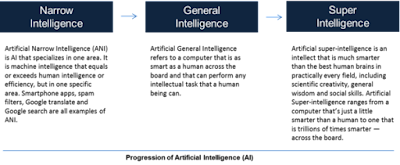
Weak or narrow AI, in contrast to strong AI, is made up of programs created to address a single issue and lacks awareness since it is not meant to have broad cognitive capacities. 

Autonomous cars and IBM's Watson supercomputer are two examples. 

Nevertheless, AGI is defined in computer science as an intelligent system having full or comprehensive knowledge as well as cognitive computing skills.


As of right now, there are no real AGI systems; they are still the stuff of science fiction. 

The long-term objective of these systems is to perform as well as humans do. 

However, due to AGI's superior capacity to acquire and analyze massive amounts of data at a far faster rate than the human mind, it may be possible for AGI to be more intelligent than humans.


Artificial intelligence (AI) is now capable of carrying out a wide range of functions, including providing tailored suggestions based on prior web searches. 

Additionally, it can recognize various items for autonomous cars to avoid, recognize malignant cells during medical inspections, and serve as the brain of home automation. 

Additionally, it may be utilized to find possibly habitable planets, act as intelligent assistants, be in charge of security, and more.


Naturally, AGI seems to far beyond such capacities, and some scientists are concerned this may result in a dystopian future. 

Elon Musk said that sentient AI would be more hazardous than nuclear war, while Stephen Hawking advised against its creation because it would see humanity as a possible threat and act accordingly.


Despite concerns, most scientists agree that genuine AGI is decades or perhaps centuries away from being developed and must first meet a number of requirements (which are always changing) in order to be achieved. 

These include the capacity for logic, tact, puzzle-solving, and making decisions in the face of ambiguity. 


Additionally, it must be able to plan, learn, and communicate in natural language, as well as represent information, including common sense. 

AGI must also have the capacity to detect (hear, see, etc.) and output the ability to act, such as moving items and switching places to explore. 


How far along are we in the process of developing artificial general intelligence, and who is involved?

In accordance with a 2020 study from the Global Catastrophic Risk Institute (GCRI), academic institutions, businesses, and different governmental agencies are presently working on 72 recognized AGI R&D projects. 


According to the poll, projects nowadays are often smaller, more geographically diversified, less open-source, more focused on humanitarian aims than academic ones, and more centered in private firms than projects in 2017. 

The comparison also reveals a decline in projects with academic affiliations, an increase in projects sponsored by corporations, a rise in projects with a humanitarian emphasis, a decline in programs with ties to the military, and a decline in US-based initiatives.


In AGI R&D, particularly military initiatives that are solely focused on fundamental research, governments and organizations have very little roles to play. 

However, recent programs seem to be more varied and are classified using three criteria, including business projects that are engaged in AGI safety and have humanistic end objectives. 

Additionally, it covers tiny private enterprises with a variety of objectives including academic programs that do not concern themselves with AGI safety but rather the progress of knowledge.

One of the most well-known organizations working on AGI is Carnegie Mellon University, which has a project called ACT-R that aims to create a generic cognitive architecture based on the basic cognitive and perceptual functions that support the human mind. 

The project may be thought of as a method of describing how the brain is structured such that different processing modules can result in cognition.


Another pioneering organization testing the limits of AGI is Microsoft Research AI, which has carried out a number of research initiatives, including developing a data set to counter prejudice for machine-learning models. 

The business is also investigating ways to advance moral AI, create a responsible AI standard, and create AI strategies and evaluations to create a framework that emphasizes the advancement of mankind.


The person behind the well-known video game franchises Commander Keen and Doom has launched yet another intriguing endeavor. 

Keen Technologies, John Carmack's most recent business, is an AGI development company that has already raised $20 million in funding from former GitHub CEO Nat Friedman and Cue founder Daniel Gross. 

Carmack is one of the AGI optimists who believes that it would ultimately help mankind and result in the development of an AI mind that acts like a human, which might be used as a universal remote worker.


So what does AGI's future hold? 

The majority of specialists are doubtful that AGI will ever be developed, and others believe that the urge to even develop artificial intelligence comparable to humans will eventually go away. 

Others are working to develop it so that everyone will benefit.

Nevertheless, the creation of AGI is still in the planning stages, and in the next decades, little progress is anticipated. 

Nevertheless, throughout history, scientists have debated whether developing technologies with the potential to change people's lives will benefit society as a whole or endanger it. 

This proposal was considered before to the invention of the vehicle, during the development of AC electricity, and when the atomic bomb was still only a theory.


~ Jai Krishna Ponnappan

Find Jai on Twitter | LinkedIn | Instagram


You may also want to read more about Artificial Intelligence here.

Be sure to refer to the complete & active AI Terms Glossary here.


AI - What Is Superintelligence AI? Is Artificial Superintelligence Possible?


In its most common use, the phrase "superintelligence" refers to any degree of intelligence that at least equals, if not always exceeds, human intellect, in a broad sense.


Though computer intelligence has long outperformed natural human cognitive capacity in specific tasks—for example, a calculator's ability to swiftly interpret algorithms—these are not often considered examples of superintelligence in the strict sense due to their limited functional range.


In this sense, superintelligence would necessitate, in addition to artificial mastery of specific theoretical tasks, some kind of additional mastery of what has traditionally been referred to as practical intelligence: a generalized sense of how to subsume particulars into universal categories that are in some way worthwhile.


To this day, no such generalized superintelligence has manifested, and hence all discussions of superintelligence remain speculative to some degree.


Whereas traditional theories of superintelligence have been limited to theoretical metaphysics and theology, recent advancements in computer science and biotechnology have opened up the prospect of superintelligence being materialized.

Although the timing of such evolution is hotly discussed, a rising body of evidence implies that material superintelligence is both possible and likely.


If this hypothesis is proved right, it will very certainly be the result of advances in one of two major areas of AI research: 


  1. Bioengineering 
  2. Computer science


The former involves efforts to not only map out and manipulate the human DNA, but also to exactly copy the human brain electronically through full brain emulation, also known as mind uploading.


The first of these bioengineering efforts is not new, with eugenics programs reaching back to the seventeenth century at the very least.

Despite the major ethical and legal issues that always emerge as a result of such efforts, the discovery of DNA in the twentieth century, together with advances in genome mapping, has rekindled interest in eugenics.

Much of this study is aimed at gaining a better understanding of the human brain's genetic composition in order to manipulate DNA code in the direction of superhuman intelligence.


Uploading is a somewhat different, but still biologically based, approach to superintelligence that aims to map out neural networks in order to successfully transfer human intelligence onto computer interfaces.


  • The brains of insects and tiny animals are micro-dissected and then scanned for thorough computer analysis in this relatively new area of study.
  • The underlying premise of whole brain emulation is that if the brain's structure is better known and mapped, it may be able to copy it with or without organic brain tissue.


Despite the fast growth of both genetic mapping and whole brain emulation, both techniques have significant limits, making it less likely that any of these biological approaches will be the first to attain superintelligence.


The genetic alteration of the human genome, for example, is constrained by generational constraints.

Even if it were now feasible to artificially boost cognitive functioning by modifying the DNA of a human embryo (which is still a long way off), it would take an entire generation for the changed embryo to evolve into a fully fledged, superintelligent human person.

This would also imply that there are no legal or moral barriers to manipulating the human DNA, which is far from the fact.

Even the comparatively minor genetic manipulation of human embryos carried done by a Chinese physician as recently as November 2018 sparked international outrage (Ramzy and Wee 2019).


Whole brain emulation, on the other hand, is still a long way off, owing to biotechnology's limits.


Given the current medical technology, the extreme levels of accuracy necessary at every step of the uploading process are impossible to achieve.

Science and technology currently lack the capacity to dissect and scan human brain tissue with sufficient precision to produce full brain simulation results.

Furthermore, even if such first steps are feasible, researchers would face significant challenges in analyzing and digitally replicating the human brain using cutting-edge computer technology.


Many analysts believe that such constraints will be overcome, although the timeline for such realizations is unknown.


Apart from biotechnology, the area of AI, which is strictly defined as any type of nonorganic (particularly computer-based) intelligence, is the second major path to superintelligence.

Of course, the work of creating a superintelligent AI from the ground up is complicated by a number of elements, not all of which are purely logistical in nature, such as processing speed, hardware/software design, finance, and so on.

In addition to such practical challenges, there is a significant philosophical issue: human programmers are unable to know, and so cannot program, that which is superior to their own intelligence.


Much contemporary research on computer learning and interest in the notion of a seed AI is motivated in part by this worry.


Any machine capable of changing reactions to stimuli based on an examination of how well it performs in relation to a predetermined objective is defined as the latter.

Importantly, the concept of a seed AI entails not only the capacity to change its replies by extending its base of content knowledge (stored information), but also the ability to change the structure of its programming to better fit a specific job (Bostrom 2017, 29).

Indeed, it is this latter capability that would give a seed AI what Nick Bostrom refers to as "recursive self-improvement," or the ability to evolve iteratively (Bostrom 2017, 29).

This would eliminate the requirement for programmers to have an a priori vision of super intelligence since the seed AI would constantly enhance its own programming, with each more intelligent iteration writing a superior version of itself (beyond the human level).

Such a machine would undoubtedly cast doubt on the conventional philosophical assumption that robots are incapable of self-awareness.

This perspective's proponents may be traced all the way back to Descartes, but they also include more current thinkers like John Haugeland and John Searle.


Machine intelligence, in this perspective, is defined as the successful correlation of inputs with outputs according to a predefined program.


As a result, robots differ from humans in type, the latter being characterized only by conscious self-awareness.

Humans are supposed to comprehend the activities they execute, but robots are thought to carry out functions mindlessly—that is, without knowing how they work.

Should it be able to construct a successful seed AI, this core idea would be forced to be challenged.

The seed AI would demonstrate a level of self-awareness and autonomy not readily explained by the Cartesian philosophical paradigm by upgrading its own programming in ways that surprise and defy the forecasts of its human programmers.

Indeed, although it is still speculative (for the time being), the increasingly possible result of superintelligent AI poses a slew of moral and legal dilemmas that have sparked a lot of philosophical discussion in this subject.

The main worries are about the human species' security in the case of what Bostrom refers to as a "intelligence explosion"—that is, the creation of a seed AI followed by a possibly exponential growth in intellect (Bostrom 2017).


One of the key problems is the inherently unexpected character of such a result.


Humans will not be able to totally foresee how superintelligent AI would act due to the autonomy entailed by superintelligence in a definitional sense.

Even in the few cases of specialized superintelligence that humans have been able to construct and study so far—for example, robots that have surpassed humans in strategic games like chess and Go—human forecasts for AI have shown to be very unreliable.

For many critics, such unpredictability is a significant indicator that, should more generic types of superintelligent AI emerge, humans would swiftly lose their capacity to manage them (Kissinger 2018).


Of all, such a loss of control does not automatically imply an adversarial relationship between humans and superintelligence.


Indeed, although most of the literature on superintelligence portrays this relationship as adversarial, some new work claims that this perspective reveals a prejudice against machines that is particularly prevalent in Western cultures (Knight 2014).

Nonetheless, there are compelling grounds to believe that superintelligent AI would at the very least consider human goals as incompatible with their own, and may even regard humans as existential dangers.

For example, computer scientist Steve Omohundro has claimed that even a relatively basic kind of superintelligent AI like a chess bot would have motive to want the extinction of humanity as a whole—and may be able to build the tools to do it (Omohundro 2014).

Similarly, Bostrom has claimed that a superintelligence explosion would most certainly result in, if not the extinction of the human race, then at the very least a gloomy future (Bostrom 2017).

Whatever the benefits of such theories, the great uncertainty entailed by superintelligence is obvious.

If there is one point of agreement in this large and diverse literature, it is that if AI research is to continue, the global community must take great care to protect its interests.


Hardened determinists who claim that technological advancement is so tightly connected to inflexible market forces that it is simply impossible to change its pace or direction in any major manner may find this statement contentious.


According to this determinist viewpoint, if AI can deliver cost-cutting solutions for industry and commerce (as it has already started to do), its growth will proceed into the realm of superintelligence, regardless of any unexpected negative repercussions.

Many skeptics argue that growing societal awareness of the potential risks of AI, as well as thorough political monitoring of its development, are necessary counterpoints to such viewpoints.


Bostrom highlights various examples of effective worldwide cooperation in science and technology as crucial precedents that challenge the determinist approach, including CERN, the Human Genome Project, and the International Space Station (Bostrom 2017, 253).

To this, one may add examples from the worldwide environmental movement, which began in the 1960s and 1970s and has imposed significant restrictions on pollution committed in the name of uncontrolled capitalism (Feenberg 2006).


Given the speculative nature of superintelligence research, it is hard to predict what the future holds.

However, if superintelligence poses an existential danger to human existence, caution would dictate that a worldwide collaborative strategy rather than a free market approach to AI be used.


~ Jai Krishna Ponnappan

Find Jai on Twitter | LinkedIn | Instagram


You may also want to read more about Artificial Intelligence here.


See also: 


Berserkers; Bostrom, Nick; de Garis, Hugo; General and Narrow AI; Goertzel, Ben; Kurzweil, Ray; Moravec, Hans; Musk, Elon; Technological Singularity; Yudkowsky, Eliezer.


References & Further Reading:


  • Bostrom, Nick. 2017. Superintelligence: Paths, Dangers, Strategies. Oxford, UK: Oxford University Press.
  • Feenberg, Andrew. 2006. “Environmentalism and the Politics of Technology.” In Questioning Technology, 45–73. New York: Routledge.
  • Kissinger, Henry. 2018. “How the Enlightenment Ends.” The Atlantic, June 2018. https://www.theatlantic.com/magazine/archive/2018/06/henry-kissinger-ai-could-mean-the-end-of-human-history/559124/.
  • Knight, Heather. 2014. How Humans Respond to Robots: Building Public Policy Through Good Design. Washington, DC: The Project on Civilian Robotics. Brookings Institution.
  • Omohundro, Steve. 2014. “Autonomous Technology and the Greater Human Good.” Journal of Experimental & Theoretical Artificial Intelligence 26, no. 3: 303–15.
  • Ramzy, Austin, and Sui-Lee Wee. 2019. “Scientist Who Edited Babies’ Genes Is Likely to Face Charges in China.” The New York Times, January 21, 2019


Artificial Intelligence - What Is The Turing Test?


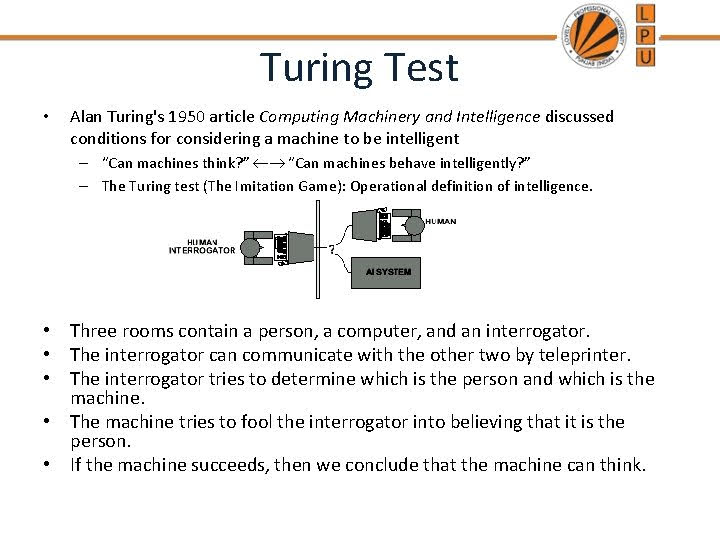
The Turing Test is a method of determining whether or not a machine can exhibit intelligence that mimics or is equivalent and likened to Human intelligence. 

The Turing Test, named after computer scientist Alan Turing, is an AI benchmark that assigns intelligence to any machine capable of displaying intelligent behavior comparable to that of a person.

Turing's "Computing Machinery and Intelligence" (1950), which establishes a simple prototype—what Turing calls "The Imitation Game," is the test's locus classicus.

In this game, a person is asked to determine which of the two rooms is filled by a computer and which is occupied by another human based on anonymized replies to natural language questions posed by the judge to each inhabitant.

Despite the fact that the human respondent must offer accurate answers to the court's queries, the machine's purpose is to fool the judge into thinking it is human.


According to Turing, the machine may be considered intelligent to the degree that it is successful at this job.

The fundamental benefit of this essentially operationalist view of intelligence is that it avoids complex metaphysics and epistemological issues about the nature and inner experience of intelligent activities.

According to Turing's criteria, little more than empirical observation of outward behavior is required for predicting object intelligence.

This is in sharp contrast to the widely Cartesian epistemological tradition, which holds that some internal self-awareness is a need for intelligence.

Turing's method avoids the so-called "problem of other minds" that arises from such a viewpoint—namely, how to be confident of the presence of other intelligent individuals if it is impossible to know their thoughts from a presumably required first-person perspective.


Nonetheless, the Turing Test, at least insofar as it considers intelligence in a strictly formalist manner, is bound up with the spirit of Cartesian epistemol ogy.

The machine in the Imitation Game is a digital computer in the sense of Turing: a set of operations that may theoretically be implemented in any material.


A digital computer consists of three parts: a knowledge store, an executive unit that executes individual orders, and a control that regulates the executive unit.


However, as Turing points out, it makes no difference whether these components are created using electrical or mechanical means.

What matters is the formal set of rules that make up the computer's very nature.

Turing holds to the core belief that intellect is inherently immaterial.

If this is true, it is logical to assume that human intellect functions in a similar manner to a digital computer and may therefore be copied artificially.


Since Turing's work, AI research has been split into two camps: 


  1. those who embrace and 
  2. those who oppose this fundamental premise.


To describe the first camp, John Haugeland created the term "good old-fashioned AI," or GOFAI.

Marvin Minsky, Allen Newell, Herbert Simon, Terry Winograd, and, most notably, Joseph Weizenbaum, whose software ELIZA was controversially hailed as the first to pass the Turing Test in 1966.


Nonetheless, detractors of Turing's formalism have proliferated, particularly in the past three decades, and GOFAI is now widely regarded as a discredited AI technique.

John Searle's Minds, Brains, and Programs (1980), in which Searle builds his now-famous Chinese Room thought experiment, is one of the most renowned criticisms of GOFAI in general—and the assumptions of the Turing Test in particular.


In the latter, a person with no prior understanding of Chinese is placed in a room and forced to correlate Chinese characters she receives with other Chinese characters she puts out, according to an English-scripted software.


Searle thinks that, assuming adequate mastery of the software, the person within the room may pass the Turing Test, fooling a native Chinese speaker into thinking she knew Chinese.

If, on the other hand, the person in the room is a digital computer, Turing-type tests, according to Searle, fail to capture the phenomena of understanding, which he claims entails more than the functionally accurate connection of inputs and outputs.

Searle's argument implies that AI research should take materiality issues seriously in ways that Turing's Imitation Game's formalism does not.

Searle continues his own explanation of the Chinese Room thought experiment by saying that human species' physical makeup—particularly their sophisticated nerve systems, brain tissue, and so on—should not be discarded as unimportant to conceptions of intelligence.


This viewpoint has influenced connectionism, an altogether new approach to AI that aims to build computer intelligence by replicating the electrical circuitry of human brain tissue.


The effectiveness of this strategy has been hotly contested, although it looks to outperform GOFAI in terms of developing generalized kinds of intelligence.

Turing's test, on the other hand, may be criticized not just from the standpoint of materialism, but also from the one of fresh formalism.


As a result, one may argue that Turing tests are insufficient as a measure of intelligence since they attempt to reproduce human behavior, which is frequently exceedingly dumb.


According to certain variants of this argument, if criteria of rationality are to distinguish rational from illogical human conduct in the first place, they must be derived a priori rather than from real human experience.

This line of criticism has gotten more acute as AI research has shifted its focus to the potential of so-called super-intelligence: forms of generalized machine intelligence that far outperform human intellect.


Should this next level of AI be attained, Turing tests would seem to be outdated.

Furthermore, simply discussing the idea of superintelligence would seem to need additional intelligence criteria in addition to severe Turing testing.

Turing may be defended against such accusation by pointing out that establishing a universal criterion of intellect was never his goal.


Indeed, according to Turing (1997, 29–30), the purpose is to replace the metaphysically problematic issue "can machines think" with the more empirically verifiable alternative: 

"What will happen when a computer assumes the role [of the man in the Imitation Game]" (Turing 1997, 29–30).


Thus, Turing's test's above-mentioned flaw—that it fails to establish a priori rationality standards—is also part of its strength and drive.

It also explains why, since it was initially presented three-quarters of a century ago, it has had such a lengthy effect on AI research in all domains.


~ Jai Krishna Ponnappan

Find Jai on Twitter | LinkedIn | Instagram


You may also want to read more about Artificial Intelligence here.


See also: 

Blade Runner; Chatbots and Loebner Prize; ELIZA; General and Narrow AI; Moral Turing Test; PARRY; Turing, Alan; 2001: A Space Odyssey.


References And Further Reading

Haugeland, John. 1997. “What Is Mind Design?” Mind Design II: Philosophy, Psychology, Artificial Intelligence, edited by John Haugeland, 1–28. Cambridge, MA: MIT Press.

Searle, John R. 1997. “Minds, Brains, and Programs.” Mind Design II: Philosophy, Psychology, Artificial Intelligence, edited by John Haugeland, 183–204. Cambridge, MA: MIT Press.

Turing, A. M. 1997. “Computing Machinery and Intelligence.” Mind Design II: Philosophy, Psychology, Artificial Intelligence, edited by John Haugeland, 29–56. Cam￾bridge, MA: MIT Press.


Artificial Intelligence - Who Is Daniel Dennett?


At Tufts University, Daniel Dennett(1942–) is the Austin B. Fletcher Professor of Philosophy and Co-Director of the Center for Cognitive Studies.

Philosophy of mind, free will, evolutionary biology, cognitive neuroscience, and artificial intelligence are his main areas of study and publishing.

He has written over a dozen books and hundreds of articles.

Much of this research has focused on the origins and nature of consciousness, as well as how naturalistically it may be described.

Dennett is also an ardent atheist, and one of the New Atheism's "Four Horsemen." Richard Dawkins, Sam Harris, and Christopher Hitchens are the others.

Dennett's worldview is naturalistic and materialistic throughout.

He opposes Cartesian dualism, which holds that the mind and body are two distinct things that merge.

Instead, he contends that the brain is a form of computer that has developed through time due to natural selection.

Dennett also opposes the homunculus theory of the mind, which holds that the brain has a central controller or "little man" who performs all of the thinking and emotion.

Dennett, on the other hand, argues for a viewpoint he refers to as the numerous drafts model.

According to his theory, which he lays out in his 1991 book Consciousness Explained, the brain is constantly sifting through, interpreting, and editing sensations and inputs, forming overlapping drafts of experience.

Dennett later used the metaphor of "fame in the brain" to describe how various aspects of ongoing neural processes are periodically emphasized at different times and under different circumstances.

Consciousness is a story made up of these varied interpretations of human events.

Dennett dismisses the assumption that these ideas coalesce or are structured in a central portion of the brain, which he mockingly refers to as "Cartesian theater." The brain's story is made up of a never-ending, un-centralized flow of bottom-up awareness that spans time and place.

Dennett denies the existence of qualia, which are subjective individual experiences such as how colors seem to the human eye or how food feels.

He does not deny that colors and tastes exist; rather, he claims that the sensation of color and taste does not exist as a separate thing in the human mind.

He claims that there is no difference between human and computer "sensation experiences." According to Dennett, just as some robots can discern between colors without people deciding that they have qualia, so can the human brain.

For Dennett, the color red is just the quality that brains sense and which is referred to as red in the English language.

It has no extra, indescribable quality.

This is a crucial consideration for artificial intelligence because the ability to experience qualia is frequently seen as a barrier to the development of Strong AI (AI that is functionally equivalent to that of a human) and as something that will invariably distinguish human and machine intelligence.

However, if qualia do not exist, as Dennett contends, it cannot constitute a stumbling block to the creation of machine intelligence comparable to that of humans.

Dennett compares our brains to termite colonies in another metaphor.

Termites do not join together and plot to form a mound, but their individual activities cause it to happen.

The mound is the consequence of natural selection producing uncomprehending expertise in cooperative mound-building rather than intellectual design by the termites.

To create a mound, termites don't need to comprehend what they're doing.

Likewise, comprehension is an emergent attribute of such abilities.

Brains, according to Dennett, are control centers that have evolved to respond swiftly and effectively to threats and opportunities in the environment.

As the demands of responding to the environment grow more complicated, understanding emerges as a tool for dealing with them.

On a sliding scale, comprehension is a question of degree.

Dennett, for example, considers bacteria's quasi-comprehension in response to diverse stimuli and computers' quasi-comprehension in response to coded instructions to be on the low end of the range.

On the other end of the spectrum, he placed Jane Austen's comprehension of human social processes and Albert Einstein's understanding of relativity.

However, they are just changes in degree, not in type.

Natural selection has shaped both extremes of the spectrum.

Comprehension is not a separate mental process arising from the brain's varied abilities.

Rather, understanding is a collection of these skills.

Consciousness is an illusion to the extent that we recognize it as an additional element of the mind in the shape of either qualia or cognition.

In general, Dennett advises mankind to avoid positing understanding when basic competence would suffice.

Humans, on the other hand, often adopt what Dennett refers to as a "intentional position" toward other humans and, in some cases, animals.

When individuals perceive acts as the outcome of mind-directed thoughts, emotions, wants, or other mental states, they adopt the intentional viewpoint.

This is in contrast to the "physical posture" and the "design stance," according to him.

The physical stance is when anything is seen as the outcome of simply physical forces or natural principles.

Gravity causes a stone to fall when it is dropped, not any conscious purpose to return to the ground.

An action is seen as the mindless outcome of a preprogrammed, or predetermined, purpose in the design stance.

An alarm clock, for example, beeps at a certain time because it was built to do so, not because it chose to do so on its own.

In contrast to both the physical and design stances, the intentional stance considers behaviors and acts as though they are the consequence of the agent's deliberate decision.

It might be difficult to decide whether to apply the purposeful or design perspective to computers.

A chess-playing computer has been created with the goal of winning.

However, its movements are often indistinguishable from those of a human chess player who wants or intends to win.

In fact, having a purposeful posture toward the computer's behavior, rather than a design stance, improves human interpretation of its behavior and capacity to respond to it.

Dennett claims that the purposeful perspective is the greatest strategy to adopt toward both humans and computers since it works best in describing both human and computer behavior.

Furthermore, there is no need to differentiate them in any way.

Though the intentional attitude considers behavior as agent-driven, it is not required to take a position on what is truly going on inside the human or machine's internal workings.

This posture provides a neutral starting point from which to investigate cognitive competency without presuming a certain explanation of what's going on behind the scenes.

Dennett sees no reason why AI should be impossible in theory since human mental abilities have developed organically.

Furthermore, by abandoning the concept of qualia and adopting an intentional posture that relieves people of the responsibility of speculating about what is going on in the background of cognition, two major impediments to solving the hard issue of consciousness have been eliminated.

Dennett argues that since the human brain and computers are both machines, there is no good theoretical reason why humans should be capable of acquiring competence-driven understanding while AI should be intrinsically unable.

Consciousness in the traditional sense is illusory, hence it is not a need for Strong AI.

Dennett does not believe that Strong AI is theoretically impossible.

He feels that society's technical sophistication is still at least fifty years away from producing it.

Strong AI development, according to Dennett, is not desirable.

Humans should strive to build AI tools, but Dennett believes that attempting to make computer pals or colleagues would be a mistake.

Such robots, he claims, would lack human moral intuitions and understanding, and hence would not be able to integrate into human society.

Humans do not need robots to provide friendship since they have each other.

Robots, even AI-enhanced machines, should be seen as tools to be utilized by humans alone.


~ Jai Krishna Ponnappan

You may also want to read more about Artificial Intelligence here.


See also: 


Cognitive Computing; General and Narrow AI.


Further Reading:


Dennett, Daniel C. 1987. The Intentional Stance. Cambridge, MA: MIT Press.

Dennett, Daniel C. 1993. Consciousness Explained. London: Penguin.

Dennett, Daniel C. 1998. Brainchildren: Essays on Designing Minds. Cambridge, MA: MIT Press.

Dennett, Daniel C. 2008. Kinds of Minds: Toward an Understanding of Consciousness. New York: Basic Books.

Dennett, Daniel C. 2017. From Bacteria to Bach and Back: The Evolution of Minds. New York: W. W. Norton.

Dennett, Daniel C. 2019. “What Can We Do?” In Possible Minds: Twenty-Five Ways of Looking at AI, edited by John Brockman, 41–53. London: Penguin Press.

Analog Space Missions: Earth-Bound Training for Cosmic Exploration

What are Analog Space Missions? Analog space missions are a unique approach to space exploration, involving the simulation of extraterrestri...